Friday, March 27, 2020

The first impression of Mongolia: a country full of a whole lot of nothing

As we are approaching the northern border of China, the province of Inner Mongolia lets us know that it indeed has something to do with Mongolia. There is a lot of space and not so many people, signs are written not only in Chinese, but also in some kind of snake characters, and sometimes there are buildings in the shape of yurts (very kitschy and ugly, though). Some drivers even are on their way to Mongolia, but they are going to small border crossings we are not allowed to take with our passports.


The Big Sky Country no. 1 


On our way to the border town of Erenhot, we hitch a ride with a driver who quickly becomes the Chinese champion in pantomime for us: unlike almost any other Chinese people before, he gestures a lot while he talks and is able to tell us a lot of things just by moving his hands. He also smiles a lot and uses facial expression. Communication with him is almost easy.

In Erenhot, I get a stomach bug. For the first time on this trip, on our last day in China. So I eat a plenty of activated charcoal for dinner, and we go to sleep early in a meticulously maintained city park. Even though we are hidden pretty well and don’t even use the tent, a gardener rats us out to cops early in the morning, and they throw us out – for the first time in China. They try asking us questions but I keep saying ‟Munguo!” and point towards Mongolia. I’m not sure it works – nobody has ever understood anything I’ve tried saying in Chinese yet. The cops give up quite quickly, though. We catch up on lost sleep (and I complete the healing of my stomach) in another park so that we are fit when we get to the border.

Getting out of China here is far less tedious than getting in from Kazakhstan, though. There still is a compulsory bus that we partially hitch a ride with, and partially pay with the last of our Chinese cash (not enough), but there are just two or three security checks instead of five or six, and way fewer cops, scanners and electrical fences. There also seem to be zero bathrooms on the Mongolian side of the customs. When I ask an officer where to find one, she points me to a place that seems to be back in the area before the passport counters. (I might have crossed illegally back to China for toilet and then back to Mongolia by some kind of a service corridor, but I’m not sure about that.)

Outside the customs house, there is just a vast, completely flat, empty field, and the border town of Zamiin-Uud in the distance. We have to go back on the bus again to get there, and we end up on a dusty market place – the only square there is. We manage to get some Mongolian cash, buy some supplies, refill water and charge our phones in a local diner. For untrained European minds, getting around seems easier than in China. Even though we don’t understand the language either, the unknown words are at least written in Cyrillic, and places and shops are easier to identify by how they look. We are back in the ancient Soviet part of the world, and it shows. 


The city of Zamiin-Uud


We also transcribe the Mongolian translation of our hitchhiking letter for drivers on a piece of paper. We had it translated by Vojta’s Mongolian friend Ari who does her studies in Czechia. When Vojta had told her he wanted to go to Mongolia, she was genuinely surprised. Why would anyone want to go there? Why by hitchhiking? Nobody does that in Mongolia. She translated the letter for us, though. She changed the wording because she found the original one impolite and deleted the last sentence saying ‟if giving us a ride does not suit you, don’t worry, we will find another car”. I had added this sentence for Iran because I was afraid people would think we were in trouble and would want to save us. For Mongolia, Ari found the sentence even more impolite than the rest. Her version of the letter goes like this: ‟Hello, we are traveling from Europe to Mongolia by hitchhiking only. Our mission is to do this for free, without the use of any paid transport. Would you please help us reaching our goal by giving us a ride a part of the way you are going, even though we cannot pay you?” 


Getting to the outskirts of the town takes just several minutes. The town consists of a few dozens of paved and dirt streets. Finding the road to Ulaanbaatar, the country’s capital, is also easy – it is the only paved one; also the only one in the vast, dry emptiness all around the town that seems to actually be going somewhere.

Our plan for now is to try hitchhiking to a Buddhist monastery near the road to Ulaanbaatar, some 200 km north, not far from the town of Sainshand. I actually have no plan at all except for going to Ulaanbaatar to get Russian visa at some point, but Vojta wants to see some culture sites, just like in China. I like the idea because it always gives us an excuse to go to a destination, and on the way we meet people. On the map, there seems to be a small road directly to the site, and that’s encouraging. In general, the map doesn’t show any roads whatsoever to smaller towns.

Vojta has been to Mongolia before and says that to most of the towns, there actually are no roads at all. People just drive through the steppe and don’t care about roads. I wonder how they can make several hundred kilometers like this, but it seems they can. We are afraid we would get lost in the steppe so we prefer sticking to roads, though.

Fortunately for us, there indeed are some cars on the road we chose. We stop a bit behind the boundary between the town and the sheer nothingness, and we start hitchhiking.

We just wait a couple of minutes. The third or fourth car stops, and the driver agrees to give us a ride. We don’t even need the hitchhiking letter because the crew speak a bit of English. I’m wondering whether this is usual, or whether our first English speaker will also end up being almost the only one, like in China. Just like Ari, the people in the car are surprised we decided to come to Mongolia. They tell us they are students and are going to Ulaanbaatar. At first, I find it surprising that we already found a car going to the capital on the border. But it actually isn’t surprising at all because there just are 2 or 3 towns and some villages between this place and Ulaanbaatar, even though the distance is over 700 km.

After several kilometers, our drivers stop for a picture at a massive gate in the form of two camels marking the entrance to Zamiin-Uud. There is one more tin statue of a camel, and that’s all there is. All around us up to the round horizon, there is vast, flat, empty land covered by nothing but sand and grass. When I was in the US state of Montana, I found out its nickname was The Big Sky Country. I bet the person who came up with this nickname had never been to Mongolia because I’ve never seen a sky as big as now.


Only now, I realize we really are in Mongolia. For years, I’ve been planing to hitchhike to Mongolia, and now we’ve reached it. It hasn’t been the only goal of this trip – not even the most important one as we’ve mainly wanted to travel and to meet people on the way. And the trip is far from over – but as I’m staring at the huge emptiness I still can’t help feeling a deep sense of accomplishment.


Unexpected camping issues 


We keep going for several hours – and all the time, there is nothing around us. After maybe 100 kilometers, there is a small rise in the landscape and the grass looks a bit greener; then there is more of nothing.

At evening, we arrive to Sainshand, the town not far from the Buddhist monastery. Our drivers ask us if we really are sure we want to get out here and if we really don’t want to go to continue to Ulaanbaatar with them. That sounds scary but Sainshand looks like an island of civilization in this middle of nowhere – there are buildings and people and all.

The town would be easy to cross by walking but the driver drives us through and drops us just on the outskirts, at the beginning of the road to the monastery.

Finding a camping place poses a completely different difficulty than in China: in China, we had to hide because not staying in hotels was illegal. Here, nobody really cares and there is no place to hide on the steppe anyway; but as there are not many roads, pretty much all of the steppe can be used as a road. So we need to find a spot with no car tracks, where we are unlikely to be hit by a lonely car in our sleep. Eventually, we put up the tent next to an oboo: a sacred pile of stones with an animal skull on the top of a small hill. This place feels safe and it also looks badass.

At night, the vast sky looks almost disturbing. It has billions of stars as there is almost no light pollution. The presence of some kind of a city next to us feels almost reassuring. 


An oboo next to our camping site


The power of swastika 


In the morning, it’s the asphalt on our road to nowhere that feels reassuring. A clear line that marks the way to a specific spot on the globe seems almost cozy here. A car comes after a while, and we soon get to the Khamar Monastery. It is a completely isolated place in the desert, even though there are quite a few cars parked nearby, and it looks like nothing I have seen before.

The monastery consists of several buildings – one of them is a round shrine with a kind of a strangely shaped colorful tower. There also are golden statues, prayer flags fluttering in the wind and prayer mills of various sizes. Everything is colorful, which strongly contrasts with the gray color of the desert all around. Such a decorated place in the middle of nowhere feels very surreal. As usual, I don’t understand the meaning and symbolism of anything, but the atmosphere of the place still has effect on me. I enter one of the buildings, and there are many people doing some kind of a prayer or ritual. I feel like an intruder, but even though I have no idea what they are doing, it is peaceful and relaxing and I don’t feel like leaving. Then they start distributing some ribbons to each other, and I don’t know what the ribbons serve for and what to do with them, so I sneak out.


The main building is decorated with a line of swastikas all around the outer wall. I am not sure what exactly this symbolizes here, I only know for sure it does not mean the same thing as in Europe. Despite that, it is quite strange to see a sanctuary covered by something I know as a Nazi sign.


On our way back to civilization, the first driver leaves us somewhere on the road and steers to the empty steppe. We then wait for quite some time because there is nobody passing by, but then a car comes from an unexpected direction – from the steppe again. We can see it approaching for ages – first as a hardly visible cloud of dust, and then we realize that is going very fast given that it is just driving on uneven dirt with grass. Then it stops for us as if it was a completely natural thing to do.

Back in Sainshand, we try to refill our water supply for the journey to Ulaanbaatar. It is hard. It’s not only difficult to find drinking water – it’s actually hard to find any water whatsoever. There are no public bathrooms, equipped gas stations, public taps or restaurants anywhere. The tap water in the only restaurant we find is not potable. Eventually, we have to buy a big bottle and use it to refill the bottles we carry.

As we are roaming through the city, a young lady addresses us in English. She asks why we are here, and is wondering whether we are lost. She is our second English-speaking person in two days, which is quite impressive given that there are not many people here in general.

In the evening, a driver leaves us near a checkpoint on the road to Ulaanbaatar. We start looking for an oboo to camp next to, and we are stopped by an officer from the checkpoint. He wants to know where we are going (at least we think so).
“To Ulaanbaatar,“ we say.
“But do you have a GPS?“
We say we do, and he lets us go. No questions about passports – not getting lost in the steppe seems to be what matters. His question makes me wonder how many people like us have gotten lost in the steppe, and it’s a bit disturbing.


Saturday, January 11, 2020

The further adventures of illiterate hitchhikers in China: towns of the same name, mysteries of an ancient city, and how we became vandals

The unfamiliarity of China and of its language can’t be overcome in just a few weeks. You can get used to it, though. Eventually, you are no longer confused about being confused. While we are hitchhiking from the sacred mountain near the city of Xi’an towards the border with Mongolia, we regularly get into situations that we or the other people just don’t understand. It has become a routine for us. These situations are usually awkward. Sometimes they are hilarious, though. And sometimes they are a true mystery.

Inner Mongolia

A mysterious town near the city of Taiyuan


In the Xi’an region, it was so boiling hot that it was painful to even walk to the toll gate and start hitchhiking. On the same day more north, the temperature suddenly drops by some 20°C. I suddenly feel happy and able to do things again. It’s incredible how heat turns me to a lifeless zombie, and how normal temperature turns me back to a human being. (And it’s even more incredible that for Vojta it makes no difference.) When we get out of the truck in the suburbs of Taiyuan, it is raining, the air is mild and I am the happiest person in the world.

Vojta wants to see a historical site nearby and the driver is almost going past. We don’t even have to go downtown. This is another reason to be happy; it is hard to hitchhike and to find camping spots in cities. And it is particularly difficult to get around in Chinese cities in general if the only thing you understand is your map, whereas people around you don’t really read maps. A map doesn’t help you much to use the public transport either. So we try avoiding Chinese cities at all cost. So far, we’ve been incredibly lucky; the only major city we’ve been to is Xi’an – and we went there on purpose. Now we seem to be lucky again. The Jinci Temple is 2 kilometers away. We comfortably walk to the village, order noodles in a local diner (we already know how to do that if there are pictures of meals) and pitch the tent in a nearby park. It’s the first time we are using this tent in rain (our families brought this tent for us to Kyrgyzstan) and it’s leaking. It can’t spoil my happiness, though – we just cover the tent with Vojta’s big raincoat and the issue is solved.


We spend the next day in the temple. It is a vast garden with pavilions, lakes, statues and massive trees. The inscriptions say it is almost 1500 years old. I find it as unfamiliar as most of the things in China but it is a spiritual place and I enjoy walking around all the strangely shaped pavilions and towers. It is also raining the whole day and everything is fresh and green and I love it. 


The Jinci temple

To continue north, we decide to avoid the big city of Taiyuan completely. This requires walking a few more kilometers and hitching a ride on a small road across the mountains. There are hardly any cars and we get stuck. Late in the afternoon, we get picked up by a guy and a little girl with a van. The guy doesn’t seem confused at seeing us hitchhiking, which actually is confusing. We show him our list of sentences in Chinese saying what we are doing, and he seems to understand.

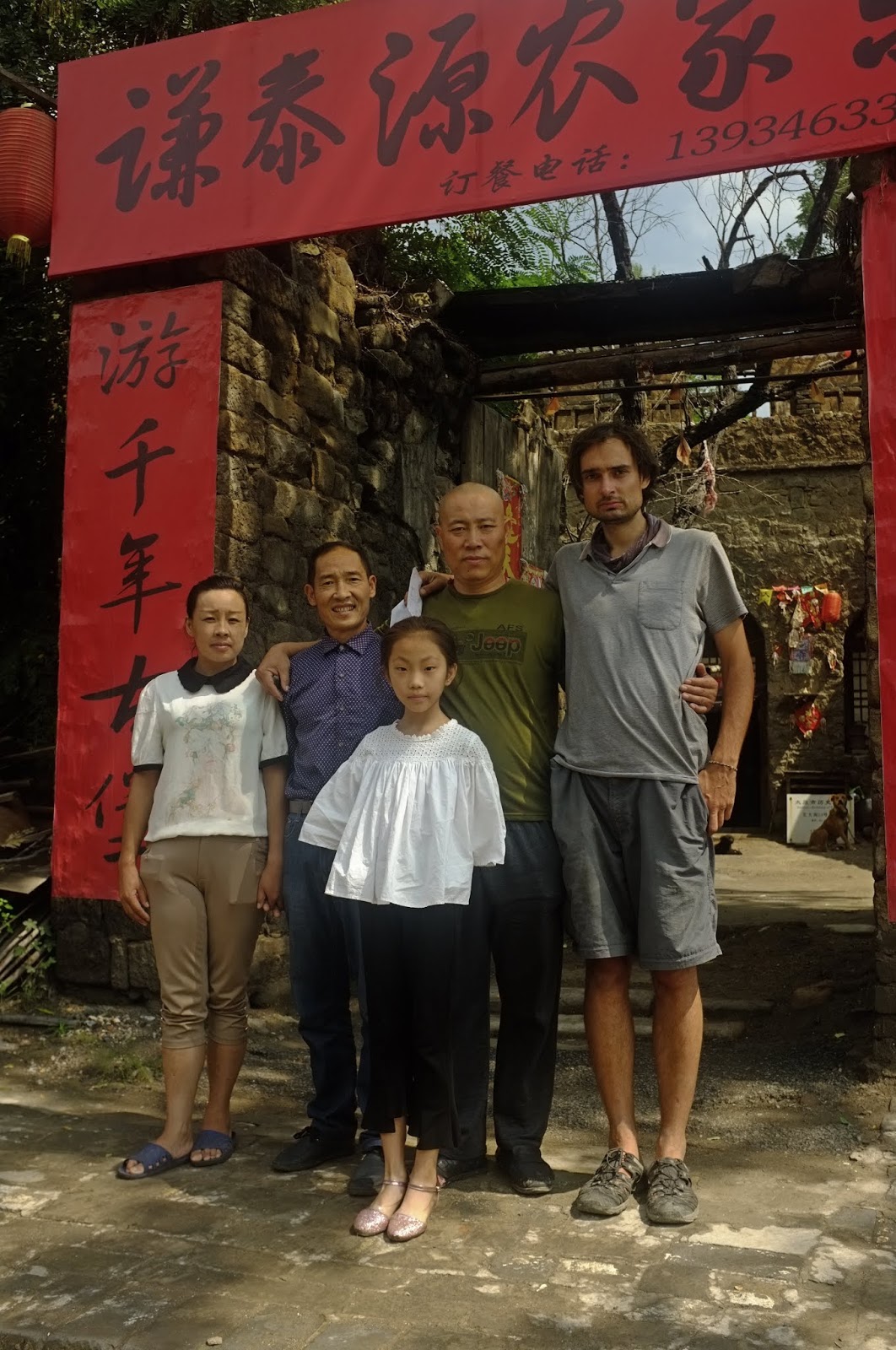
Then, he leaves the road and brings us to a deserted ancient village in a small river valley. The hillside is covered by a cascade of stone houses pressed against each other, and stairs. Except from round red Chinese lanterns suspended on roofs or wooden structures, the village looks completely abandoned. The only house that looks used is the one belonging to our driver. He shows us we can sleep somewhere in the village and tells us to come back in the morning. At least we think so. We don’t manage to ask him where exactly we can put up our tent, though, so we start exploring the village.


The houses look historical but we are not exactly sure how to tell anything historical in China. Some of the houses are decorated on the outside but they still are crumbling, some of their roofs are missing and they are mostly empty. We have no idea how old this place is, why it’s abandoned and why it’s decorated. In one of the houses, the lights are on. The door is a bit open, so we can see a lady monk sitting on the ground, maybe praying. We don’t want to disturb her but as she is the only person around, we dare knocking on the door and try to ask her if we can put up a tent nearby. She says something without any gesture and we don’t have the slightest clue what that was. So we give up and just find a nice place for the tent on one of the terraces, with a nice view of the valley.

In the morning, we continue exploring the place: the village is pretty big, with narrow lanes and staircases between houses that look almost identical. In some of them, there are some items, such as brooms, wooden containers, basic farming tools or new chairs that totally don’t seem to belong here. One of the houses near the river looks fake, like a stage for a theater play. On the road in front of the village, there are some signs we can’t read, a map we can’t read either, and many pictures from movies. Vojta comes up with a theory that the whole place might have been built as a scenery for shooting a famous movie. It might also just be a crumbling village where a movie has been shot.


We go to see the driver who brought us here yesterday. He greets us and offers us instant noodles – the same brand we always buy. At least something is familiar here. He shows us his house – he lives in a place that looks like ancient cellars, and the temperature inside is nicely fresh. He also shows us a text handwritten in English, related to this place. We try to decipher the handwriting to find out something, but it’s hard and the text seems to just be a visitors book entry.


The guy asks us some questions too but we are not able to answer. We try to tell him to write the questions on our phone in order to run it through the translation app, but he just writes them on a piece of paper and we are not really able to copy it into the phone, so we can’t figure out what he is asking. So except for our hitchhiking letters, we stay as mysterious for him as he and his village do for us.


Helpful police and a less helpful toll gate officer


When we have crossed the mountains, we join the motorway again. Even though this is not the police province of Xinjinag, we sometimes still seem to disturb the police or the toll gate staff when we try hitchhiking. Every toll gate is different. Sometimes, the staff don’t care at all. Sometimes they are extremely helpful. Sometimes it takes some explaining.

This time, it seems it will be difficult. The officer in charge invites us to his air-conditioned booth and asks us a lot of question. We show him all our letters, and he decides to help us. He actually insists. Through the translation app, he suggests us taking a taxi, taking a train and taking a bus. We explain him that we want to hitchhike, so he suggests he will pay a bus ticket for us. We refuse again. Eventually we convince him that hitchhiking is the only option, so he goes with us to the toll gate, stops a car with a license plate of the next city and orders the driver to give us a ride. The driver doesn’t protest at all and we feel almost sorry for him. Who would defy a police officer’s wish. This was our shortest waiting in China so far, though.


We are less lucky at the next toll gate: the lady on duty just tells us to go away. As simple as that. Thanks to her, we take a small country road and embark on the discovery of the Chinese countryside.


The onion vandals


We continue slowly, mostly with farmers going from one village to another. We also catch a ride with a guy who probably is an architect and has layouts of pavilions in his car. We walk through an entire town on foot. We become an attraction for the owners of public bathrooms in a park – they find us so funny as we wash our t-shirts that they burst out laughing and we must take a selfie with them.


When the night comes, we have hard time finding a camping spot as we are in an urbanized suburb. Eventually we find a grassy area along the road, behind a line of trees. We just need to step over a low fence. The area itself is quite vast but there are no trees, so we go rather far so that we can’t be seen from the road, and put our camping mats among a bit taller plants.

In the morning, we are woken by somebody shouting. We were probably not hidden that much well because he is shouting at us – and he is waving his arms animatedly. This helps us find out that Chinese people can indeed gesture while they talk. We also find out that we are lying in the only line of onion plants there is in the entire grassy field.

If there is a hell for travelers, once we get there, this farmer will surely show up to remind us of the onions we killed.


The cities of Shangdu


Some time later, after we hiked the sacred mountain of Heng Shan, Vojta comes up with the idea to see Shangdu, the ancient capital of Kublai Khan’s dynasty. It is in the province of Inner Mongolia and almost on the way to the border crossing to Mongolia we are planning to take.

Before we get there, people are extremely hospitable with us again, some truck drivers invite us for food and settle with a shop owner to let us camp in front of her shop.


The region of Inner Mongolia seems to be less populated than the ones before, motorways are emptier and it is not difficult to hitchhike on the entrance ramps or directly on the road.

Shangdu looks like a completely ordinary province town, except that people enjoy staring at us even more than anywhere before. They stare at us when we are buying food, they stare even more when we ask where to find a bathroom, and when we try asking for directions to the historical part of the town, a ring of more than 20 staring people forms around us. They don’t tell us any directions and actually tell us nothing at all. They are just standing and staring and when we try to smile at them or tell them our names, they just keep on staring. It’s not fun, so we just leave and try to look for the historical district on our own.

We are not sure where to start, though. The town looks anything but historical and there are none of the brown signs that everywhere in China point towards cultural sites. We can’t find anything in the map either. Eventually Vojta verifies the location of the Kublai Khan museum – and finds it’s some 300 km east in another Shangdu spelled in totally different Chinese characters. Well played. We are not even surprised anymore.

We still manage to get a cultural experience in this Shangdu though – as we embark on an urban hike back to the motorway, we come across people dancing on a square. On the ground, there is a recorder playing loud music, people stand behind it in regular lines like in an aerobic class and dance to the rhythm. We have noticed a similar dance session in Xi’an but we thought it was a special event for tourists. This town looks anything but touristy, so it probably just is a thing Chinese people do.


Dancing in Shangdu

We don’t join them as we don’t understand dancing and rhythms, but Shangdu offers us another opportunity to see some culture: on the next square, there is an open cinema. A historical drama is showed on a big screen and people sit around on boxes and stools. We of course don’t understand any dialogues but it doesn’t matter much: there are battles, a heroic warrior, a beautiful girl who does nothing, and in the end a character dies and it’s heroic and sad.

The next day we find the other Sangdu: it consists of two grassy mounds in the middle of an empty plain, and a museum. There also is a parking lot guard who speaks Japanese, and that’s nice. Not that we know anything in Japanese but he understands the concept of not understanding Chinese, so we talk about life through a dictionary and it’s kind of fun.


After leaving the ‟right” Shangdu, we are heading to Mongolia. Compared to the distance we’ve already covered, the border is very near. Our days in China are almost over. The god of hitchhikers, if there is one, must love us and be watching over us. We’ve just crossed the fourth largest country in the world, by the way a tough dictatorship, without having any idea about pretty much anything, yet everything has gone smoothly and almost everybody have been nice to us. China was the country I was the most afraid of, and now I think I will miss it, in a way.


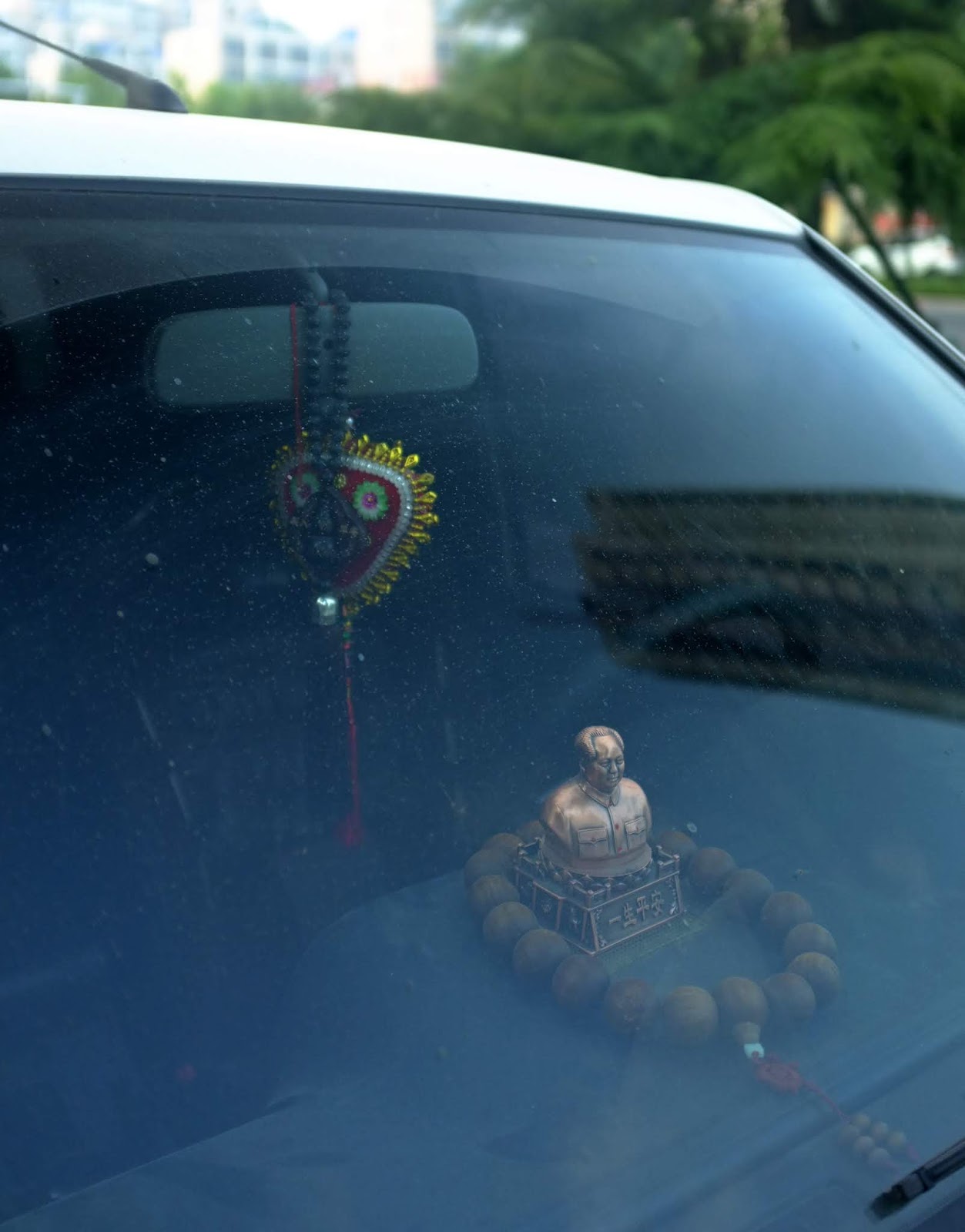
Mao is watching you


Wednesday, December 25, 2019

Hiking Hua Shan and Heng Shan the Chinese way: stairway to heaven and a printer on the top of a holy mountain

We spent most of the time remaining on our visa hiking holy mountains. You might be wondering why I am writing a blog post about it: hiking is a very ordinary thing, isn’t it? It is the same everywhere in the world. You just find a hill and a path, get some supplies, put on hiking boots and walk up until you’re on the summit, right? But in China, also hiking surprised us. Or, at least hiking holy mountains. Anyway, it deserves its own post.

On the top of Hua Shan


The importance of being well dressed

 
Dan, our young host from Xi’an, tells us about a holy Daoist mountain called Hua Shan not far from the city. She says it’s one of the five most important mountains in China. Hiking a holy mountain seems like good thing to do, so we decide to hitchhike to the place the trail starts. Dan and her family are way too hospitable and generous to let us hitchhike, though. They insist on driving us to the Huashan town at the foot of the hill themselves. In view of their incredible hospitality, we are relieved they are not trying to fly us there with a private jet or buy us a spaceship, so we don’t even protest. Dan also gives us a map of the hill and explains us in detail how to get to the top. Under the mountain, we say goodbye to each other.

We soon find out that in China, also such a simple thing as hiking is done in a very different way than we are used to.

The surroundings of the hill are very civilized – the way to the top actually starts in the city. At the foot, there is a monastery with a park where every square meter of land is carefully maintained. We want to start hiking the next morning, so we spend the afternoon in the park. We buy some food for the hike – some plastic packages of something we think might be tofu, and some purple sausages. Then we camp in an almost dry stream bed because it is the only hidden spot we can find. I don’t manage to sleep at all as the temperature is still way over 30°C.

The whole night, there is a stream of people with lights and shining phones walking past us up the hill. Hiking at night seems to be a thing. And when I say hiking, I mean walking sometimes in flip-flops or dancing shoes, fancy clothes and with umbrellas.

Early in the morning Vojta wakes up and I give up my efforts to fall asleep in a puddle of my own sweat. We hide our backpacks in shrubs at the edge of the stream bed and join the endless procession moving slowly up the hill. The number of people on the path didn’t seem to grow or drop as the day came.

As the mountain is very steep and rocky, there seems to be just one way to the top from this part of the town. There is an entrance fee to be paid at a big gate. It is more expensive than anything we have tried to buy in China so far but the price is the same for everybody. We don’t have to pay a fine for being foreigners as we had to in some other countries. (It would be pointless here anyway as pretty much all the tourists are Chinese. Pretty much all the tourists are also more elegantly dressed than us (we can again see some people in dresses and sandals even though most wear running shoes and pants one would expect).

Then, we continue to walk up. Instead of a path, there actually are gentle, polished, well-maintained stone stairs going through a gorge between cliffs, along the dry stream bed with occasional puddles of water. On the other side of the stairs, along the rock face, there is a line of stands selling drinks, fruits, instant noodles, souvenirs, hats, umbrellas and pretty much anything you can think of. Sometimes the valley gets a bit wider. On every such spot, there are colourful gazebos, benches or statues. More important spots have boards with information about the place, poems or legends. Often it also is translated into English and sometimes the translation makes sense. 


No watching while walking!

On the opposite side of the stream bed, we sometimes see small stone staircases or ladders going up the cliff, to carved holes half hidden by vegetation. We try to climb up one of these ladders, but almost immediately a guard appears, shouting at us to (probably) get down. So we go back to the crowded path and the mystery of a hole in the rock remains unsolved. 


It is early morning, the cicadas scream like crazy. The stairs going through the gorge are protected from the sun by the cliffs and trees and washed by occasional small streams of cold water running down the rock face, so the temperature is almost bearable. The shopkeepers catch the water in pipes and run it over their fruits and water bottles to keep them cool, and then the water flows down the stairs. We are walking fast because I want to cover most of the distance before the deadly heat comes.

Soon, the path gets steeper. That doesn’t mean it is any more difficult or any less maintained and polished, though. If the trail goes up a cliff, there is a perfect, comfortable staircase carved in the rock, with railing, electric lighting (now switched off) and all. We soon find ourselves on a cascade of ancient staircases, with (contemporary) artificial platforms. People use them for taking selfies. Even though we are basically climbing a cliff, at any point the ascent doesn’t get any more technical than walking up the stairs in a building.


The people with umbrellas, dressed in skirts, sandals and office shirts still look as fresh and as elegant as downstairs. We also notice the typical Chinese fashion trend: if you’re a guy with a big belly, the right summer outfit for you is to tuck your T-shirt up and roll it above your belly. If your tummy is big enough, it will hold the T-shirt rolled up. Vojta tried it too but his belly is too small, so his T-shirt keeps unrolling and falling loose. Too bad for him.


Fashion trend for this summer.


Mountain shopping


Then the slope gets less steep again – we are almost at the North Peak, one of the five peaks the mountain has. We can now see how pointy it is. The peak has the form of a narrow rocky ridge with a top we can’t really see as there is a building. Stairs and paths are carved into the rock even on places where the surface is almost horizontal. Houses and stands selling stuff appear again. There also is a shop with some dried plants, dead snakes and some things we can’t identify. That’s new – we didn’t notice a shop like that downstairs. At one of the stands, you can pose for a picture with a sword. The place is even more crowded than the hiking path as there is a top cable car station near here.
 
Wanna do something for your health? Get a dead lizard!


It is a bit windy and as we are at 1600 meters of altitude, the temperature is still nice and fresh. It is almost noon, so it will probably not get worse. From the top, we can see the land around us. The mountain seems to be rising very abruptly from a completely flat landscape.

We try to eat the purple sausages we carry for lunch, and we find out they are sweet. It’s actually the most horrible food we’ve tried in China so far. So we eat our tofu supplies instead. Luckily, there are those stands with instant noodles we’ve been making fun of.

The path continues on a ridge (it is very safe and protected with a lot of railings) to the remaining peaks. They form a kind of a pointy ring with precipitous slopes around. It is very airy and gives one vertigo a bit – I’ve never been to a mountain this pointy and steep (and this easily accessible) in Europe. Except for the crowds and tourist attractions, the mountain looks like in a fairytale.

Here on the top, there are no water streams anymore. But there still are shops selling bottled water and many other stuff. The goods are supplied by bearers who carry sticks on their shoulders with heavy load suspended in the front and in the rear. The bearers also collect waste and carry it downstairs. People throw a lot of garbage but the place is not dirty; the system seems to work.


We go to some of the other peaks. On one of them, there is a platform where people put up tents to wait for sunrise. On another, there is an open-air photo studio with a lot of printers. Tourists can have their pictures printed immediately, at 2000 m on a rocky peak. There also is a path made of planks, suspended on the rock face. It is very crowded, so we avoid it.


Along the ridge, there still are trees, pavilions, temples, ancient inscriptions (probably) and small nooks carved in the rocks. The air is fresher the higher we get, so I like the mountain more and more. I try to imagine what the place looked like centuries ago. Even with all the printers and swords and love locks on railings, the mountain seems magical.  


When we are walking down, it is already dark. As the staircase is so user-friendly, it is not even hard to climb down at night. And there still is a never-ending stream of people going up. The zigzag path below us is illuminated by hundreds of electrical lights and it looks like an Elvish kingdom. As we are descending, it’s getting hot again. We decide not to reach the scorching spot where our backpacks are, and stay in the middle of the climb even though we have no camping stuff. We just lie down on the ground in the shrubs, and after the last night up I fall asleep immediately. 


Wishes come true


Some days later, several hundred kilometers north, in a temperature lower by almost 20°C, after crossing from the Shaanxi province to Shanxi province (yep, the names are a trap for Europeans) we are hitchhiking to another holy mountain. Mount Heng is located near a town called Hunyuan and it happens to be on our way. It also is one of the five most famous sacred Daoist mountains. This time, we do our best to shop for supplies with more care and try not to buy any sweet sausages. We end up with plastic packages of unknown white content as usual. Most of it probably is tofu or vegetables and some of it are eggs. At least we hope so.

Today seems to be the day of wishes come true. In the morning, Vojta thinks about buying a water melon. Our next driver (who totally could not understand anything we might have been saying) stops at a melon stand next to the road and offers us one.

At the foot of the sacred mountain, we are looking for water on a huge parking lot near a touristy temple. There is none. It can just be bought in shops in tiny plastic bottles. So we keep walking up along the road and we find a small river dam. It is accessible and relatively clean, with no garbage on the shores. Even though nobody swims in there, there are fishers so the water is probably not too polluted either.

Besides filtering some water for drinking, we can also wash our socks and T-shirts and go swimming after a long time. The fishers on the shore stare at us as if we were some water monsters. This is the second time already, so it makes me think swimming probably is unusual, unpopular or maybe inconvenient in China. I am so happy I can bath that I don’t care, though. We eat our melon and are having such a good time that we only feel sorry we don’t have any beer to chill with. A family who is having a picnic nearby ask us to take a picture with them, and then invite us to their picnic. We manage to communicate with them a bit through a translation app. It is an elevating conversation because they understand we don’t understand Chinese. (We have not always been this lucky.) They also share their beer with us and when they need to go, they give us their remaining fruits. I’m wondering whether China is reading our minds today. It’s almost scary.


Heng Shan mountain: the ‟undeveloped part of China”


The way to the hill starts on a huge parking lot with a big building with a lot of ticket counters. Actually, most people take a bus or cable car to get to the top. We like walking, though, so we just pay the entrance fee and walk along the road. We are the only ones and it is a nice hike. There are not even too many cars passing us by.

After several kilometers, there is another huge parking lot with a line of shops and stands. The road ends here and from this point, everybody have to walk. Also this mountain has a long stone staircase instead of a path.


Heng Shan seems not as large as Hua Shan and a bit less crowded (even though it still is considerably crowded compared to mountains in Europe). It also is full of temples, caves, gazebos, shrines and boards with inscriptions in Chinese and in lousy English. All of them are on the same side of the mountain, pressed against the rock face. In one of the rooms, I come across an aged monk who tells me something and gestures when he talks, so I get an idea of what he means. It’s reassuring.


Disaster hidden trouble site

Later, we even meet a tourist who speaks English. He comes from a southern part of China and we exchange a few sentences about hiking. ‟It’s my first time here,” he says. ‟I don’t go to these undeveloped parts of the country much.” 

To me, this region seems completely normal. I knew that this part was more rural than the most touristy regions but I am surprised it actually is considered backward. I’m wondering what a developed part of China looks like. If developed means crowded and urbanized, it scares me. 


On the official top of the hill, there is a paved area where people take selfies and then go back again. There are no printers. The stairway continues on a grassy ridge but we are the only ones to follow it. Nobody else seems to care what’s behind the official summit. It’s a lovely walk, though. There are no crowds and the views are nice. Finally, even a Chinese sacred mountain feels familiar.